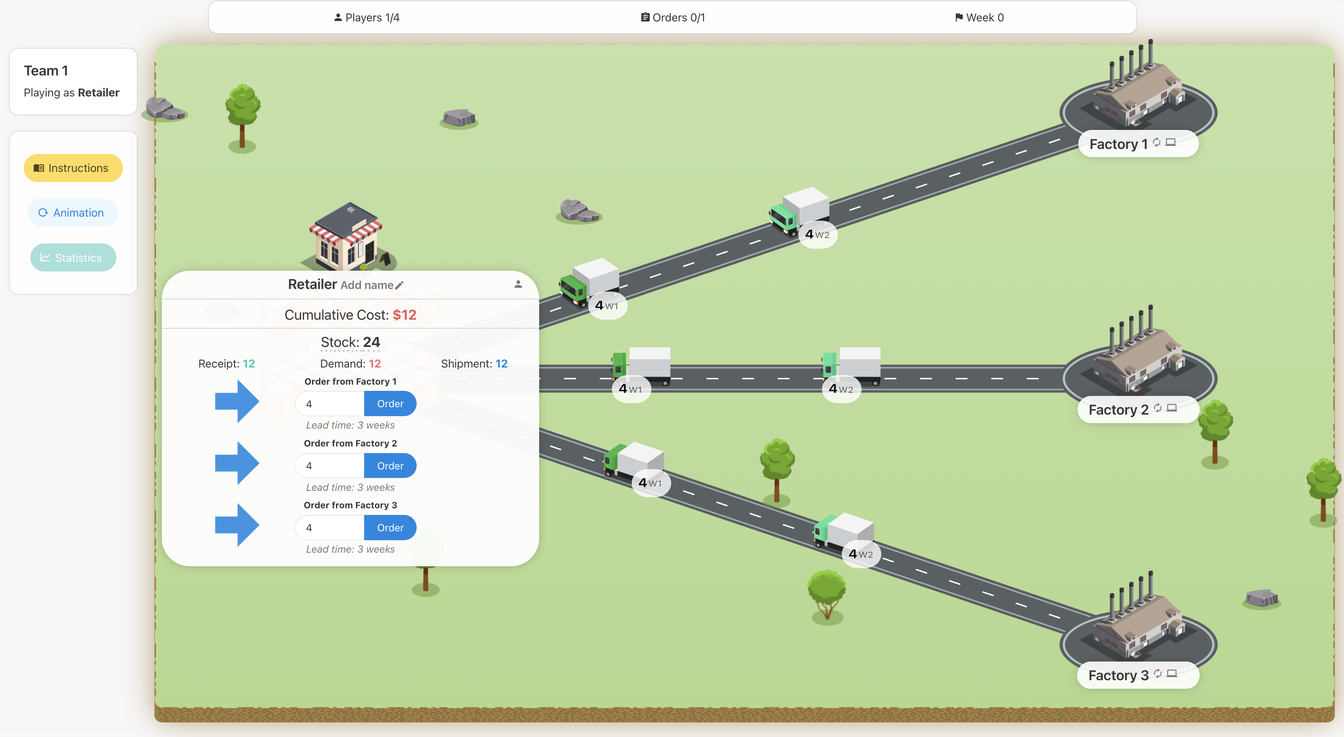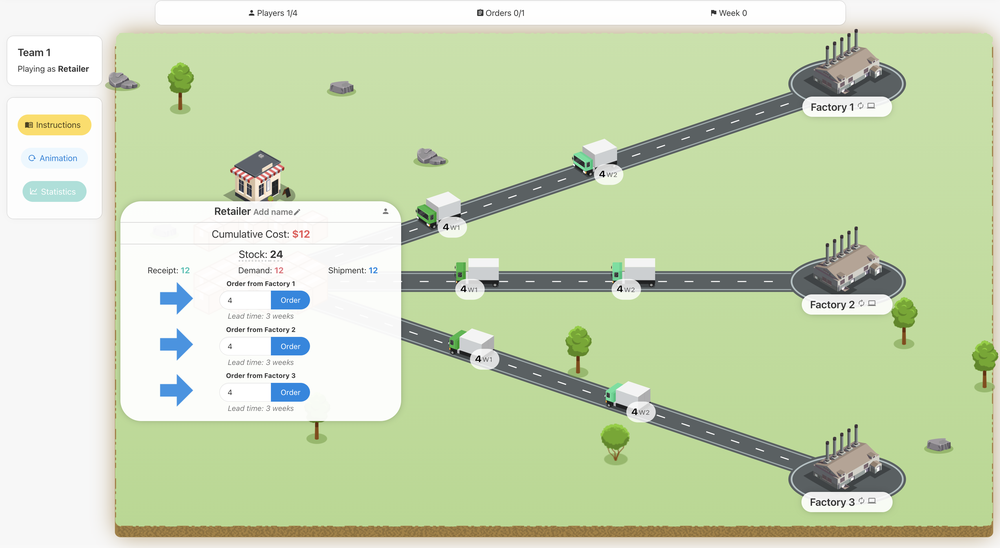
What is the Multi-Suppliers Game?
Zensimu’s Multi-Suppliers Game is an interactive, educational simulation designed to test players’ supply chain management skills in an environment of friendly competition. It offers users hands-on experience in navigating the intricate logistics and decision-making processes involved in meeting customer demand while facing unexpected disruptions.
Who is it for?
Our Multi-Suppliers Game is a great way to test lessons learned in supply chain management while fostering teambuilding and discussion in a friendly competitive simulation. This simulation can be integrated into university classrooms, consulting workshops, and in enterprise supply chain academy courses and programs.
When to use the Multi-Suppliers Game template
The simulation should be used in training sessions, educational courses, and strategy workshops to enhance understanding of supply chain management. It's particularly beneficial for:
New employee onboarding to introduce them to supply chain management best practices
Team development exercises to foster better collaboration and decision-making
Academic settings to complement theoretical knowledge with practical experience
How to use the Multi-Suppliers Game template
Instructors have an extensive set of features and options for creating a custom simulation to demonstrate essential supply chain management concepts as well as developing individual and team skills in a thought-provoking exercise. Once the game is set up and launched, players will be instantly immersed as they strive to leverage best practices in order to beat the “competition”.
Key Learnings
The simulation offers deep insights into critical aspects of supply chain management, including:
Bullwhip Effect: Understanding how demand fluctuations impact the entire supply chain, leading to inefficiencies
Capacity Constraints: How limitations on the amount of goods or services within the supply chain supply chain leads to delays, backlogs, and higher costs
Visibility: Track and access real-time or near-real-time information about products, inventory, orders, shipments, and processes across the entire supply chain
Variability: Adapting to fluctuations and inconsistency in supply chain activities, resources, and outcomes
Play our Multi-Suppliers Game today!