What is a Value Chain?
A value chain is the full set of activities a company performs to design, produce, market, deliver and support a product or service — where each activity is meant to add more value than it costs.
The concept comes from Michael Porter's 1985 book Competitive Advantage. His core idea is simple but powerful: don't treat your business as one big cost centre. Break it into the distinct activities that create the final product, and look at each one as a step that should add a measurable increment of value. Add up the value created across every activity, subtract what it cost to perform them, and what's left is your margin.
Seen this way, the value chain becomes a diagnostic tool. It tells you where your company actually creates value for the customer, where it leaks cost, and therefore where your competitive advantage can come from — either by doing things more cheaply than rivals (cost advantage) or by doing them differently in ways customers will pay more for (differentiation).
Value chain vs. supply chain: what's the difference?
These two terms get used interchangeably, but they describe different things — and the difference is worth getting right, because it changes what you optimise for.
A supply chain is the network and flow that gets a product from raw materials to the end customer: suppliers, manufacturing, warehousing, transport, distribution, and the information moving alongside the goods. The lens is operational — how do we fulfil demand reliably, at the right cost, time and quality? It's fundamentally about flow and efficiency.
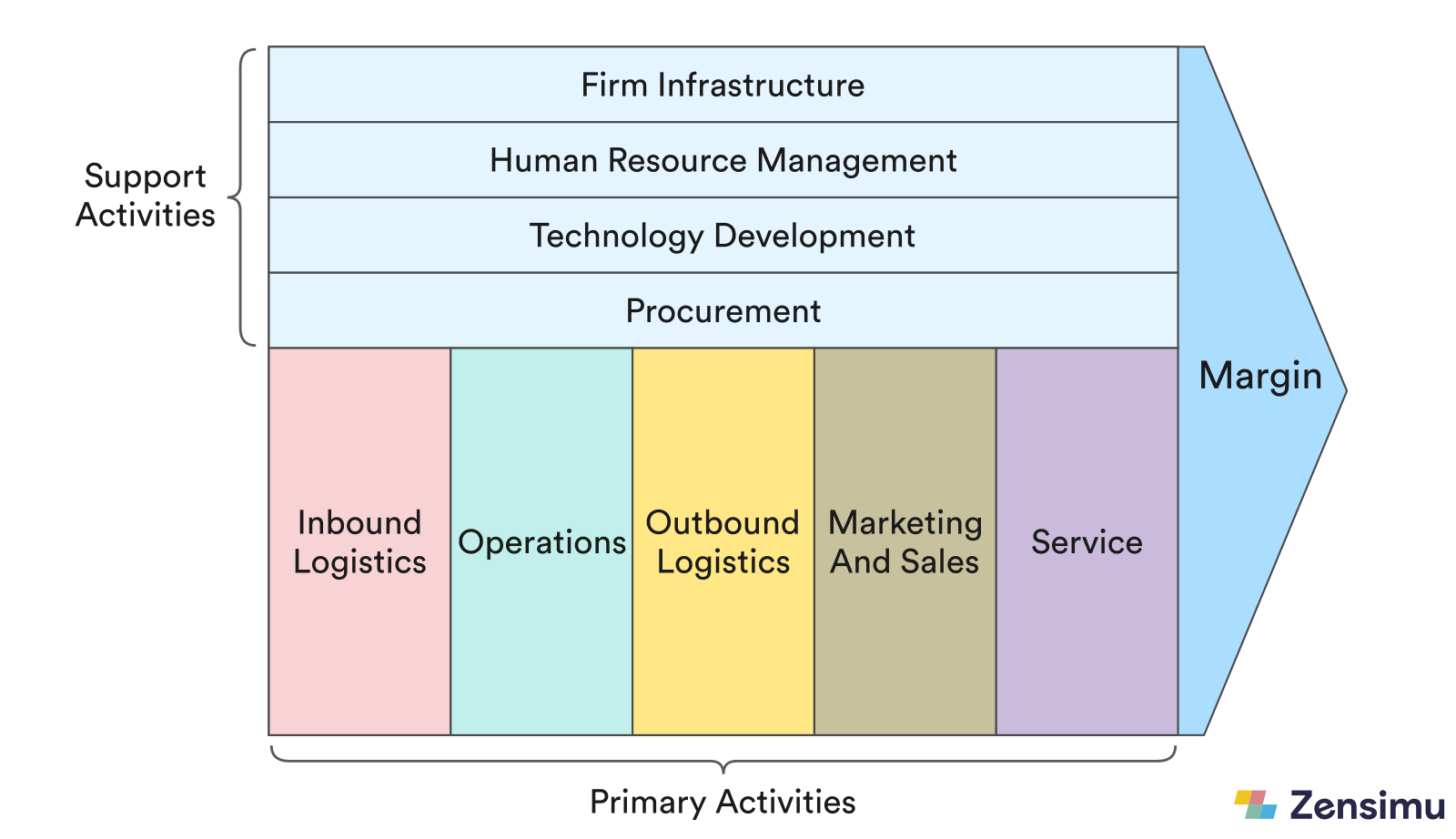
A value chain is broader and strategic. It includes that operations-and-logistics flow, but it also wraps in the demand-side activities (marketing, sales, after-sales service) and the support functions (procurement, technology, HR, infrastructure) — and it frames all of them around a single question: how does each activity create value for the customer relative to its cost?
The cleanest way to hold the two in your head: the supply chain is essentially a subset of the value chain. The operations and inbound/outbound logistics that make up a supply chain sit in the middle of Porter's primary activities. The value chain adds everything on either side — sourcing strategy, marketing, sales, service — and reframes the whole thing as value creation rather than just flow.
| Supply chain | Value chain | |
|---|---|---|
| Origin | Operations & logistics management | Business strategy (Porter, 1985) |
| Primary focus | Flow of goods, materials & information | Value created for the customer |
| Lens | Operational — efficiency, cost, reliability | Strategic - competitive advantage, margin |
| Scope | Supplier → manufacturer → distributor → customer | Supply chain plus marketing, sales, service & support functions |
| Key question | How do we deliver this efficiently? | How do we make this worth more than it costs? |
| Direction of thinking | Pushes the product out to the customer | Pulls value back from what the customer is willing to pay |
Bottom line: optimise your supply chain and you move goods faster and cheaper. Optimise your value chain and you decide where to compete — and the supply chain becomes one (important) part of that bigger picture.
The components of the value chain
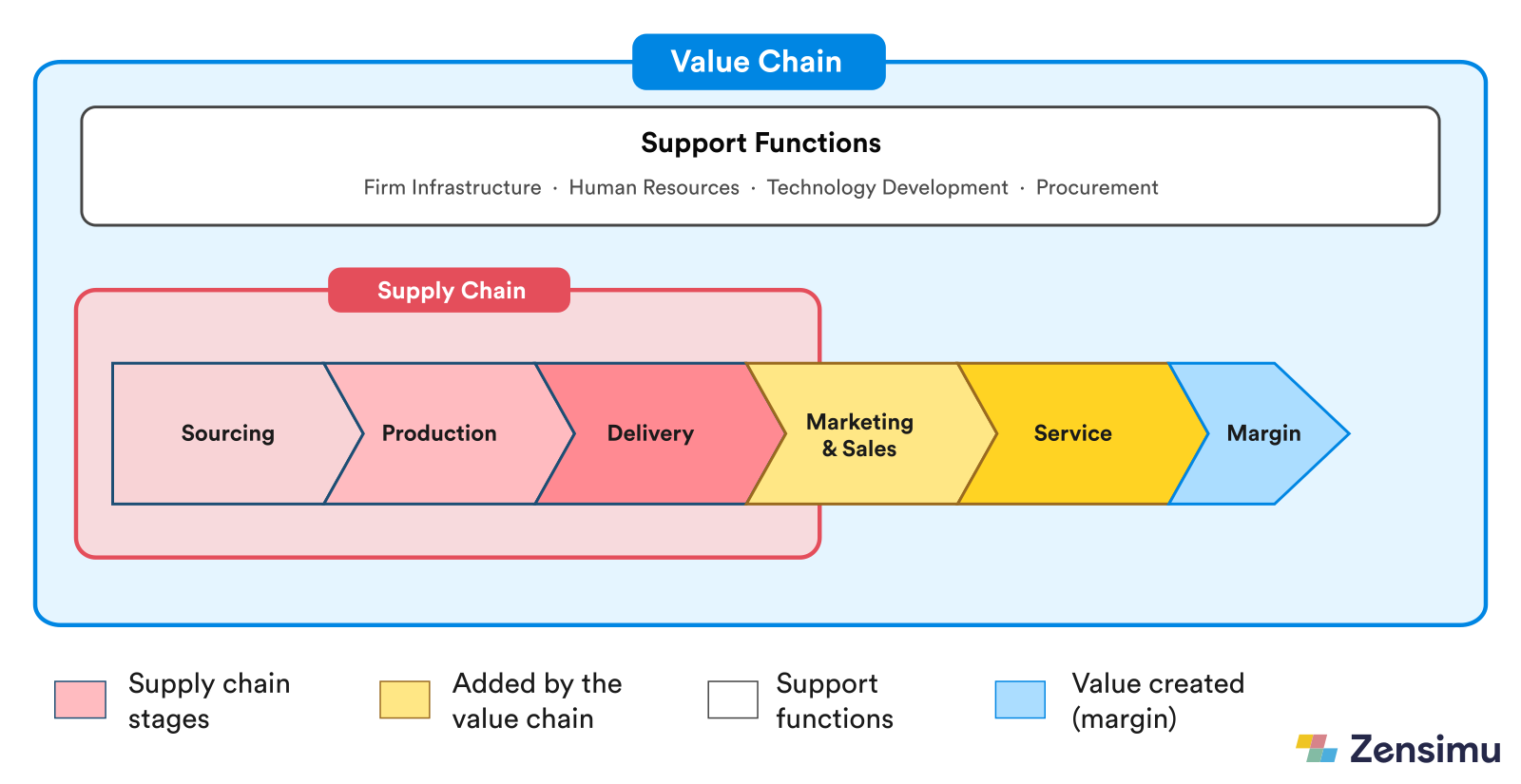
Porter splits the value chain into two groups of activities.
Primary activities — the activities directly involved in creating, selling and supporting the product:
Inbound logistics — receiving, storing and handling incoming materials.
Operations — turning inputs into the finished product or service.
Outbound logistics — getting the finished product to customers.
Marketing & sales — making customers aware of the product and giving them a reason to buy.
Service — supporting the product after the sale to maintain and increase its value.
Support activities — the activities that make the primary ones possible:
Firm infrastructure — management, finance, planning, quality.
Human resource management — recruiting, developing and retaining people.
Technology development — R&D, process improvement, systems.
Procurement — sourcing the inputs the business runs on.
The point of the breakdown isn't to file activities into boxes. It's to look at each one and ask whether it's pulling its weight: is this step adding more value than it costs, and is it adding value differently from competitors? That's where strategy lives.
Why value chain analysis matters
Mapping your value chain forces a shift in how you see the business — from "a set of costs to control" to "a set of activities that should each justify themselves through the value they create." In practice it helps you:
Find your real source of advantage — pinpoint the handful of activities where you genuinely create more value (or could), instead of spreading effort evenly.
Choose a strategy deliberately — cost advantage or differentiation — rather than drifting between the two.
Break down silos — because value is created across activities and functions, not inside any one of them. The biggest gains usually sit at the hand-offs between functions, which is exactly where most organisations are weakest.
That last point also explains why the concept scales up. Stretched across companies and countries, the same logic becomes the global value chain (GVC) — the interconnected production networks that shape modern trade. The unit changes; the question doesn't.
From theory to practice: experiencing the value chain
Here's the hard part: value chain thinking is cross-functional by definition, and cross-functional trade-offs are almost impossible to teach on a slide. You can explain that a sales decision affects operations which affects procurement — but people only really get it when they live the consequences.
That's what simulation does. In a Zensimu simulation, participants each take a functional role — sales, operations, planning, supply — and make decisions in their own area, then watch those decisions ripple across the whole chain and show up in the team's shared result. The silo-busting isn't described to them; they feel it.
Our Sales & Operations Planning simulation is the closest fit to value chain thinking — sales, operations and finance have to align around a single plan, and the trade-offs between them are the whole point.
The Beer Game is the classic entry point for understanding how decisions and information flow (and distort) along a chain — the foundation everything else builds on.
See value chain thinking in action
The fastest way to understand how decisions create or destroy value across a chain is to run one yourself.