In this article, we’ll take a look at the advantages and disadvantages of five Beer Game simulation providers, including a manual option. We hope this helps instructors confidently choose the best simulation available to create higher engagement and more effective learning experiences in their classroom or training sessions.
What is the Beer Game?
The Beer Game is an educational game. It simulates a Beer supply chain composed of 4 stages. Each participants (or group of participant) is playing as one of them.
 The players interact with each other by sending orders, supplying Beer from the factory to the end consumer. The game is organized in a way where information is missing on the demand and supply side. Players typically tries to optimize their own situation, showing hoarding behaviours and lack of collaboration. As a result, the supply chain as a whole faces growing variations in orders and stock flows, with alternate phases of shortages or overstock. This phenomenon is known as the bullwhip effect.
 The beer game is a classical exercise used in many educational and corporate environments, it helps quickly understand how supply chain systems work, their pitfalls, and which processes can help. It is a great introduction before going into more advanced topics such as supply chain planning, inventory management or even Lean Six Sigma.
While the game was initially played using physical boards, several digital versions were developed throughout the years. Let's examine the different solutions one can have to host a session!
Zensimu Beer Game
Zensimu’s version enhances the classic Beer Game with a user-friendly online platform that supports both remote and in-person group sessions. It includes an instructor dashboard, customizable scenarios and detailed post-game analytics.
The simulation is widely used in business schools, corporate training and team-building workshops (hundreds of players on a daily basis) to deepen understanding of supply-chain behaviour through interactive learning rather than lectures.

Features
Instructor Dashboard: Creating an account is free, and allows easily inviting players to your game, monitor their advancement and debrief their results through automatically-generated charts.
Scalable: Multilingual support and game monitoring features allow sessions with up to hundreds of simultaneous players, both remote or in-presence, in various environments. Power Point presentations and video support help the deployment for any audience.
Immersive: The game is designed to maintain the engagement level of a physical setting, through lively visuals, animated stock and delivery flows.
Progressive Scenarios: Participants can play multiple times with varying settings, for example a first game without communication then a second one where they can share information and collaborate on a strategy.
Comparative Analytics: When a game is finished, easily compare teams and zoom on the ones where the most interesting dynamics took place. When running iterative simulations, participants can see how their score improved with different processes or parameters.
Customizable: Start from one of the templates and adjust them to your own context. For example replace beer with soda, cars, pharmaceutical products.. You can also update lead times, include constraints such as lot size/MOQ, schedule disruption events, and more!
Advantages
High engagement and learning impact: Zensimu turns supply-chain concepts like the bullwhip effect and inventory management into an immersive, interactive game, which increases learner engagement and retention compared with traditional lectures or slide decks. The simulation requires real decisions under uncertainty, helping teams internalize concepts through experience rather than theory alone.
Scalable, customizable, and data-driven: The platform supports large audiences (up to hundreds of players) and is fully customizable. You can tailor scenarios, branding, language and complexity to your enterprise context. It also provides extensive post-game analytics (charts, reports, exports) that managers can use to assess performance and pinpoint learning gaps across teams.
Disadvantages
Less effective with minimal players: For quick tests or when playing in a single-player mode, going through the Zensimu platform may require more setup time than other, simpler alternatives. A single-player mode is available on Zensimu but the experience is less dynamic than a live session, as human emotions and miscommunication play a significant role in the bullwhip effect.
Paid licensing: Unlike some other online versions, Zensimu operates on a per-participant fee. This allows higher engagement, dedicated support, and continuous feature updates. Pricing ranges from $5-$10 per student for university use and $20-$30 per participant for corporate training.
MA-System Beer Game
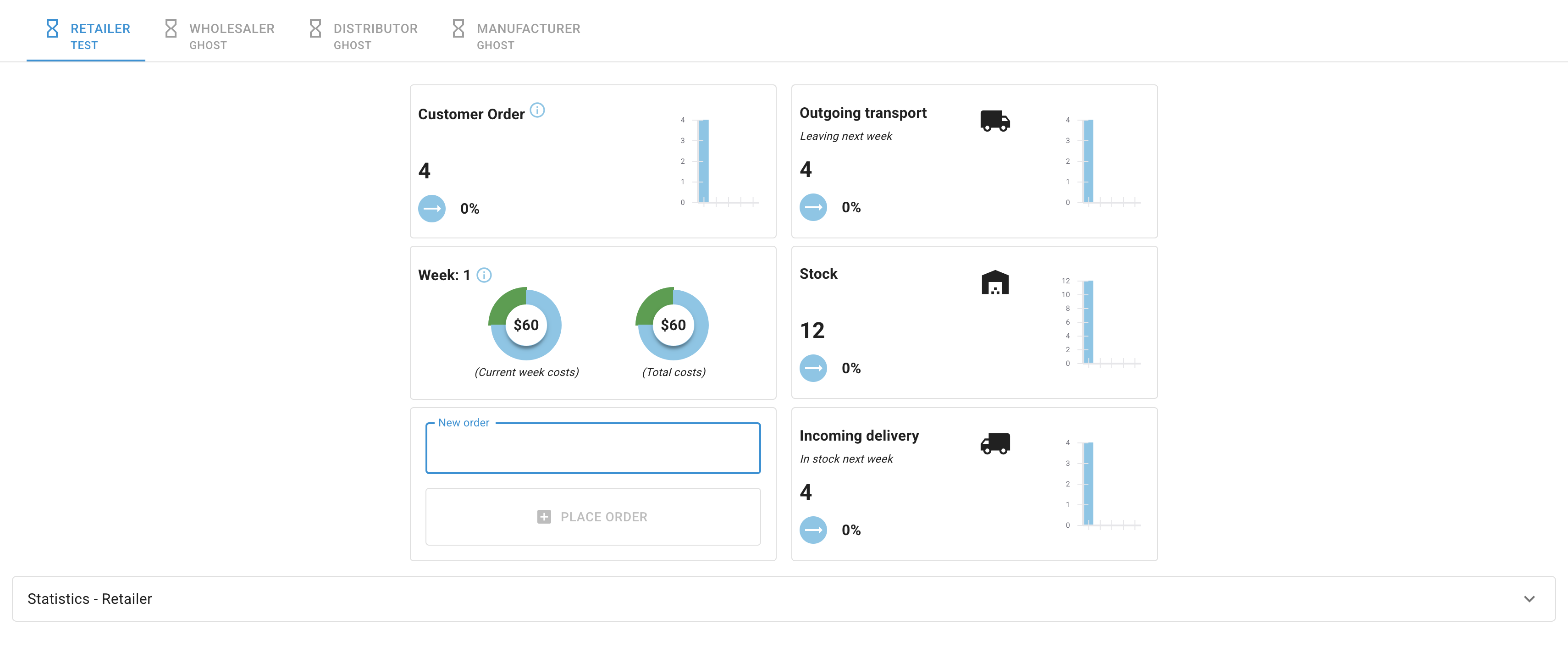
MA-System’s version offers a simplified design that works well on modern web browsers. It’s suitable for distributed single-player games, or university activity without budget. It is backed by MA-System Consulting which can help with session organization, combining play with guided discussion and reflection.
Advantages
Easy to get started: MA-System’s Beer Game allows any visitor to quickly create a simulation and join one of the roles. It doesn't require any account and is free of charge for universities, but 20$ per player for corporate use.
Lightweight application: The game can be accessed through any modern web browser. Its menus and interface are very simple, making it easy to load on poor internet networks.
Disadvantages
Scalability and Reporting challenges: The MA-System games need to be created by each player independently, and doesn't offer any instructor dashboard. This makes it difficult to monitor the advancement, compare scores and analyse the games data at debriefing. The application doesn't provide any powerpoint support or explanatory videos, which are important to ensure proper understanding by players before they start.
Less polished or customizable compared with other platforms: Because the game is maintained as a relatively simple simulation, it lacks the advanced analytics, immersive interface or customization features that help players stay engaged and understand the flows. The debriefing page includes several charts stacked on top of each other which is not ideal to visualize the progression of the bullwhip.
MIT/Forio Beer Game
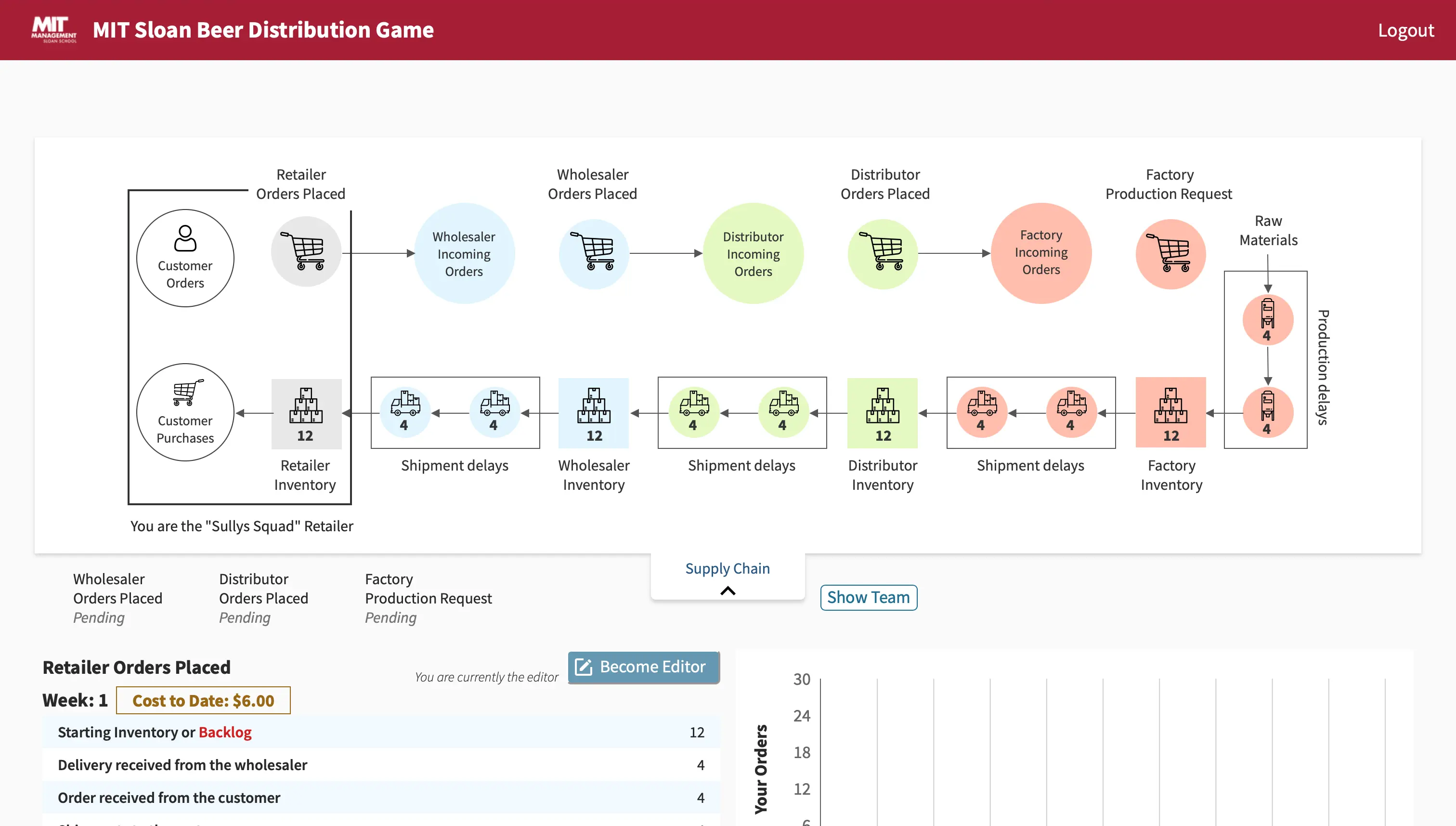
MIT created its own digital version of the game through a collaboration with Forio. Their version typically runs over a single 3-4 hours game, including an introduction, gameplay and facilitated debrief. It’s designed for multiplayer group sessions, with a facilitation guide material. Like other on-catalog simulations on Forio’s platform, it meets accessibility standards but doesn't allow customization and is more expensive than alternatives.
Advantages
Strong academic credibility and proven learning impact: The simulation and its facilitation material were developed together with MIT, ensuring pertinent debriefing content and gameplay rigor. The simulation and has been widely used in business school and executive education contexts.
Structured format with material: The package includes an optional 1:1 facilitator training. The structured format helps internal trainers run sessions smoothly. The simulation also adheres to accessibility standards (WCAG 2.0 compliance), ensuring broader participation.
Disadvantages
Higher cost compared to alternatives: Forio’s simulations typically cost $165 per person, which can be substantial for larger groups or repeated training cycles, especially compared with some modern alternatives.
Limited customization and flexibility: Unlike some newer platforms that allow extensive scenario customization, the MIT/Forio Beer Game follows a fixed structure. This can constrain trainers who want to align the simulation more precisely with unique company processes or evolving market conditions.
Transentis Beer Game
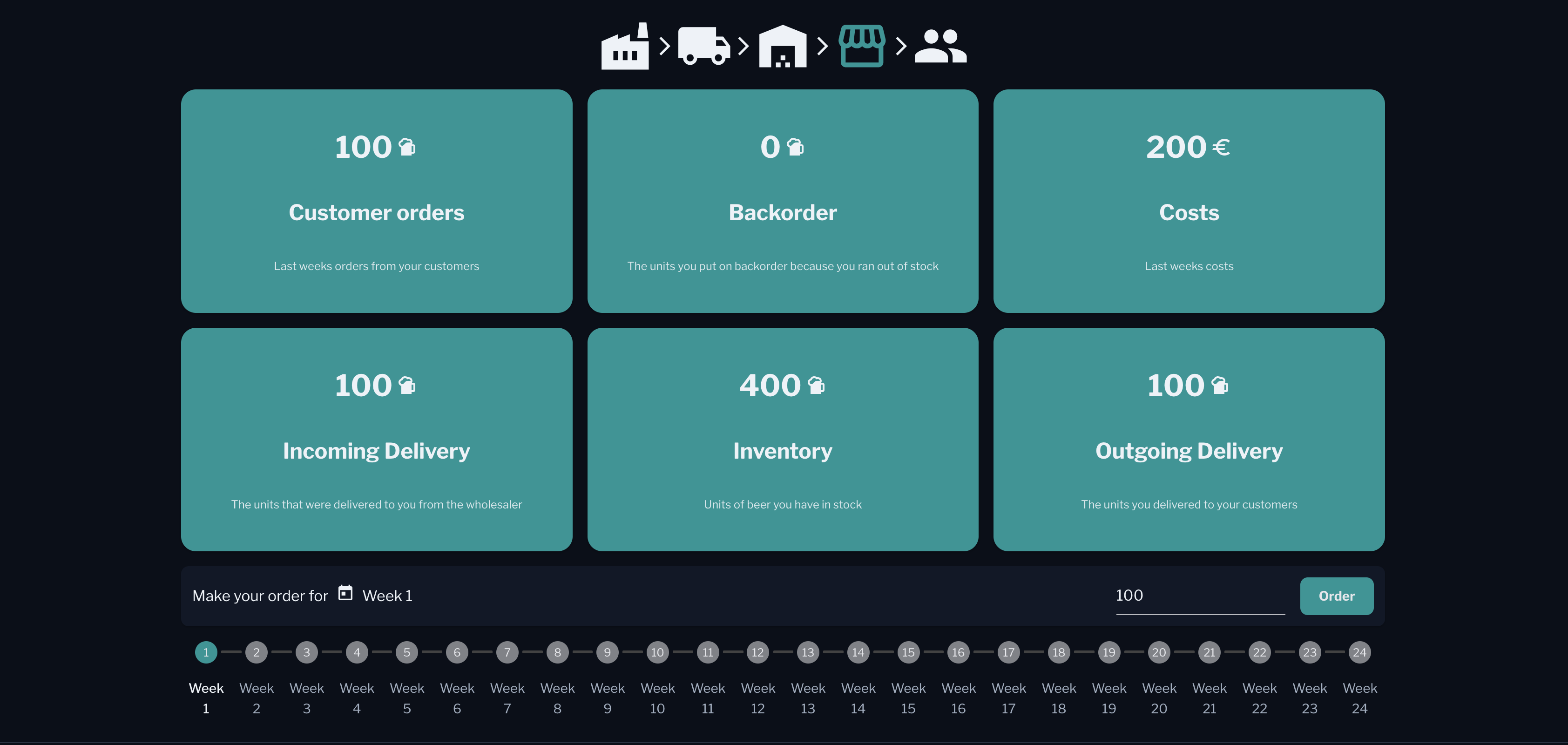
The consulting group Transentis developed its own version of the game, available via their website. The game works on any web browser without app downloads or accounts (except for the multi-team mode). The setup takes only a few minutes, either for a single-player, single-team or multi-team setup. It is a solid solution for small groups or distributed single-player setups, with no needs for customization.
Advantages
Easy setup: Transentis’s Beer Game can be launched in a few minutes with QR or lobby code access. This low-friction setup makes it practical for diverse audiences and various training environments.
Flexible session formats and robust performance data: The platform supports single-player, single-team, and multi-team modes, allowing facilitators to run multiple parallel simulations. It also offers an instructor dashboard to monitor the game advancement and analyze results at the end.
Disadvantages
Less visual and interactive: Transentis’s Beer Game interface is mostly text-based, which can make it harder for participants, especially beginners, to quickly grasp supply chain dynamics during gameplay. This can reduce engagement or learning impact for some groups.
Limited built-in facilitation controls and customization: While it offers basic settings like delivery delays or number of weeks, Transentis provides fewer session monitoring features such as assigning players to specific roles. There is no information-sharing feature between roles for a second game, which could help players practice the game in a collaborative mode.
Physical Beer Game Boards
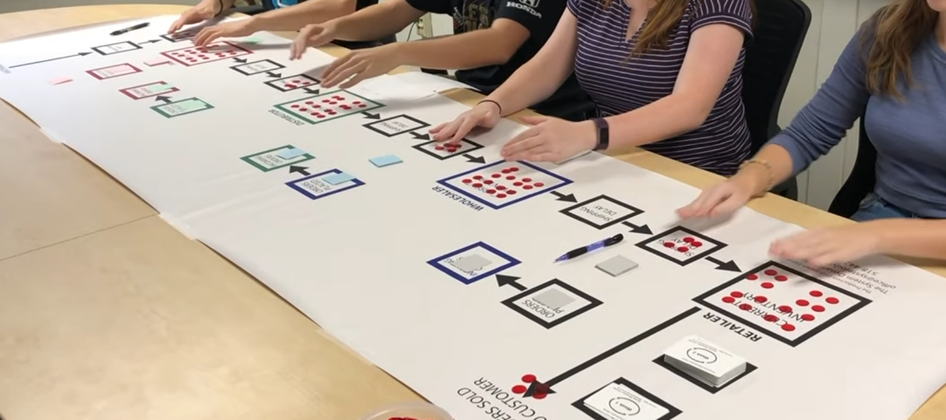
Using physical board, tokens and paper slips has been the main historic way of hosting the Beer Game since the 1960s. Despite being labor-intensive, it remains a powerful method for illustrating complex supply chain behavior and teaching participants practical, systemic insights through experiential learning.
It is possible to purchase Beer Game boards directly on the System Dynamics society website for 185$/unit.
Advantages
Highly engaging, interactive learning experience: A manual Beer Game played with physical materials (cards, paper, boards) fosters direct social interaction and hands‑on participation. Participants physically move orders and shipments, and immediately see the consequences of their actions. This tactile, collaborative setting often deepens engagement and accelerates learning through group dynamics and non-verbal communication.
In-game flexibility: Instructors can easily tailor the game on the fly, adjusting demand patterns or inserting real‑world disruptions. This flexibility helps link the exercise directly to the enterprise’s supply chain challenges without being constrained by fixed software parameters.
Disadvantages
Labor‑intensive and harder to scale: Manually tracking inventory, orders, and shipments across multiple rounds requires significant facilitator effort. For large groups, it can become chaotic and error‑prone, requiring multiple helpers and careful coordination. Without automation, data collection and performance analysis are manual and cumbersome.
Limited analytics and reporting: Unlike digital simulations, there’s no automatic dashboard, exportable data, or builtin analytics. Players must manually record outcomes (e.g., costs, orders) and send them to the teacher, to be compiled. The debriefing sometimes need to be organized a few hours/days after the game was played, reducing the learning impact.
Full Beer Game Comparison Table
| Zensimu | MA-System | MIT/Forio | Transentis | Physical Board | |
|---|---|---|---|---|---|
| Instructor dashboard | ✅ Full control (multi-teams, easy invite, messaging, debriefing) | ❌ None | ✅ Multi-games monitoring and debriefing | ✅ Multi-games monitoring and debriefing | ❌ None |
| Visual Interface | ✅ Immersive view, animated flows | ⚠ Mostly Text-based | ⚠ Mostly text and table-based | ⚠ Mostly text and table-based | ✅ Physical board and tokens |
| Invite Players options | ✅ Pre-assign on Excel or Random-Assignment, Invite via code, QR, or secret link | ⚠ Players need to create games themselves | ⚠ Strict setup with email invites and manual coordination | ⚠ Easy invite via QR or lobby code, but no specific team/role | ⚠ Manual |
| Game customization | ✅ Extensive (weeks, network, constraints, corporate branding) | ⚠ Only number of weeks | ⚠ Number of weeks, demand pattern and lead times. No "collaborative" mode | ⚠ Number of weeks, demand pattern and lead times. No "collaborative" mode | ❌ None |
| Debriefing Modes | ✅ Debriefing report for the instructor and the players. Compare teams and rounds, add Quiz or Survey | ⚠ Single-team limited report | ✅ Debriefing report with multiple charts | ✅ Debriefing report with multiple charts | ❌ Need to keep track of decisions on Excel and build charts manually |
| Teams / Scalability | ✅ Multi-instructor management, shared templates, saved sessions | ❌ Single-team debriefing, visible by players only | ❌ Single instructor only | ⚠ Saved settings preset but single instructor only | ⚠ One team/session at a time per physical board |
| Support | ✅ Help center / Email / Video call | ❌ None | ⚠ Powerpoint / Teaching notes | ⚠ Help center / Videos | ❌ None or Consulting |
| Price | Flexible options for university and business (5$-40$ per player) | $20 per player for business | 160$ per player | Free | 185$ per 4-player board |
How to pick the right Beer Game simulation tool?
After years of testing various simulation providers and building our own platform, we have identified several features that are necessary to ensure a high-quality learning experience.
Here is an overview:
Immersive visuals and animations: Despite simple rules, the supply/demand transactions happening and advancement through the weeks can be difficult to grasp for new players. Visual animations make a big difference here, improving the understandability, engagement and memorability of the experience.
Instructor dashboard: To keep your schedule and ensure no one is stuck, a proper instructor interface is crucial. This also allows you to assign/remove players easily, compare teams results and better handle debriefing discussions.
Comprehensive support material: When starting the simulation, it can take time to understand how the game works. Introductory slides and videos make this process easier and ensure players understands the rules of the game, so they can focus on strategy.
Customer support: While free tools are great for experimentation, commercial platforms provide the "safety net" of professional resources and human support.
Customization options: The classic "Beer" scenario is a great start, but you may want to adapt the game length vs. the time available, and include opportunities for improvement such as reducing lead times or information-sharing.
Scalable affordability: Pricing should align with your specific learning objectives. Whether you are a university professor or a professional hosting a training workshop, look for tiered pricing or academic discounts that reflect your group size.
Conclusion
Choosing the right tool to host your Beer Game session can seem overwhelming, as multiple providers offer this service, with different scenarios and interface layouts. Whether you prioritize academic tradition, quick mobile accessibility, or enterprise-grade scalability, this guide highlights the most robust solutions available today.
For instructors who need an immersive and fail-proof experience, we believe Zensimu stands out as the best choice. It combines ease of use and scalability with a modern, engaging user experience. This allows you to focus on what matters most: teaching the complexities of the bullwhip effect and supply chain strategy, whether you are hosting 10 students or a global seminar of 500.